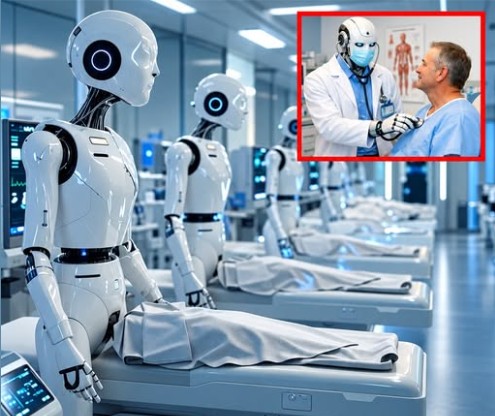
It sounds like something from the future.
But the idea behind such a hospital is becoming easier to imagine as medical technology, automation, and advanced organization continue to change the way healthcare can be delivered.
Traditional hospitals depend heavily on human staff working in shifts. Doctors examine patients, nurses monitor their conditions, technicians perform tests, and entire teams work around the clock to keep everything moving. It is demanding work, and even the most dedicated professionals need time to rest.
Now imagine a different system.
Some routine tasks could be supported by intelligent machines and automated systems. Patient information could be organized instantly. Diagnostic equipment could process large amounts of data more efficiently. Robotic systems could assist with certain procedures, while digital monitoring could continuously track vital signs and alert medical teams when something requires attention.
Instead of replacing doctors and nurses, the goal would be to give them more time for the parts of medicine that require human judgment, communication, and compassion.
A hospital designed around this concept could potentially operate continuously, with technology handling repetitive processes while medical professionals focus on patients.
The biggest change would not simply be speed.
It would be coordination.
Imagine arriving at a hospital and having your information, tests, scans, and treatment plan move through a carefully connected system instead of being delayed by paperwork or disconnected departments. In an ideal version of this model, patients could spend less time waiting and healthcare workers could spend more time caring.
Of course, technology cannot eliminate every challenge in medicine. Complex cases still require experienced professionals, difficult decisions cannot always be automated, and patients need something no machine can fully provide: human understanding.
That is why the hospital of the future may not be one where doctors and nurses disappear.
It may be one where technology works beside them.
A place that never truly stops operating, where machines can continue processing information around the clock while medical teams focus on the people who need them most.
The idea may sound futuristic today.
But as medicine continues to evolve, the line between what seems impossible and what becomes ordinary may become surprisingly thin.